A World of Art Used to Describe the Concept of Imitation
Beginnings of Impressionism
Realism, Naturalism, and The Claiming to Official Fine art

Although it was a revolutionary movement, Impressionism had roots in other styles of painting, such as Realism and Naturalism, that were already challenging conventional notions of artistic beauty and the artist's human relationship with the state.
The Realism movement, championed by Gustave Courbet, was the first to face up the official Parisian art establishment, in the middle of the xixth century. Courbet was an anarchist who thought that the fine art of his fourth dimension closed its optics on realities of life. The French were ruled by an oppressive regime and much of the public was in the throes of poverty. Instead of depicting such scenes, the artists of the time full-bodied on arcadian nudes, classical and mythological narratives, and glorifying depictions of nature. As an act of protest, Courbet financed an exhibition of his work directly reverse the Universal Exposition in Paris of 1855, a bold act that inspired future artists who sought to challenge the status quo.
At the same time, the emergence of Naturalism - a motion closely associated with Realism - showed how art could take the natural world for its bailiwick-matter without cloaking it in the contexts of historical or mythological heroism. Since the 1820s, artists such as Jean-Baptiste-Camille Corot and Jean-François Millet had been travelling to the Barbizon Forest south of Paris to create sketches en plein air of the trees, countryside, and rural laboring classes. The emergence of the Barbizon School signified the start of a global trend in painting towards depicting the natural world in all of its unadorned glory, and celebrating the lives of rural workers. While Naturalism diverges from Impressionism in its frequent accent on hyperreal detail - embodied by much of the work of Jules Bastien-Lepage - the Impressionists' celebration of the natural world for its own sake, and use of plein air technique, owes much to the earlier Naturalist ethos.
Exhibitions in Paris and The Salon des Refusés
In 1863, at the official yearly fine art salon, the all-important effect of the French art world, a large number of artists were non allowed to participate, leading to public outcry. The same year, the Salon des Refusés ("Salon of the Refused") was formed in response, to permit the exhibition of works by artists who had previously been refused entrance to the official salon. The exhibited artists included Paul Cézanne, Camille Pissarro, James Whistler, and Édouard Manet. Although it was sanctioned by Emperor Napoleon III to placate the artists involved, the 1863 exhibition was highly controversial with the public, due largely to the anarchistic themes and styles of works such as Manet's Le déjeuner sur l'herbe (1863), which featured clothed men and naked women enjoying an afternoon picnic (these women were not classical nudes, but modern women - possibly prostitutes - in a state of undress whose connotations were far more explicitly sexual).
Édouard Manet and the Painting Revolution
Édouard Manet was among the first and nearly of import innovators to emerge in the public exhibition scene in Paris. Although he grew upward in admiration of the Old Masters, he began to incorporate an innovative, looser painting style and brighter palette in the early on 1860s. He besides started to focus on images of everyday life, such every bit scenes in cafés, boudoirs, and on streets. His anti-academic mode and quintessentially modern subject-matter soon attracted the attention of artists on the fringes and influenced a new type of painting that would diverge from the standards of the time. Works such as Olympia (1863), which, like Le déjeuner sur l'herbe, depicts a mod female nude assertively against the viewer, gave the emerging Impressionist group the impetus to depict subjects not previously considered art worthy.
French Cafés and Multifariousness
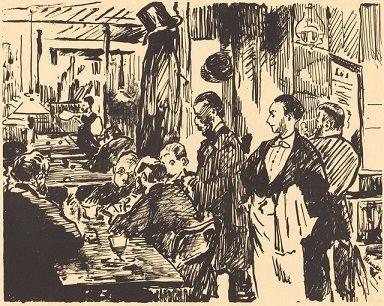
Amid the most popular venues for the painters of the emerging Impressionist move to meet and talk were Parisian cafés. In particular, Café Guerbois in Montmartre was frequented by Manet from 1866 onwards. Pierre-Auguste Renoir, Alfred Sisley, Edgar Degas, Claude Monet, Paul Cézanne, and Camille Pissarro all visited the cafe, while Caillebotte and Bazille had studios nearby, and would oft join the gatherings. Other personalities were attracted to this group, including writers, critics, and photographers.
Office of the interest of the group lay in a dynamic variety of personalities, economic circumstances, and political views. Monet, Renoir, and Pissarro had merchant family or working-course backgrounds, while Berthe Morisot, Gustave Caillebotte, and Degas were from upper-class roots. Mary Cassatt was American (and a woman) and Alfred Sisley was Anglo-French. This diversity of personalities may be the reason so much creativity arose from the grouping's collective activities.
The Impressionist Exhibitions
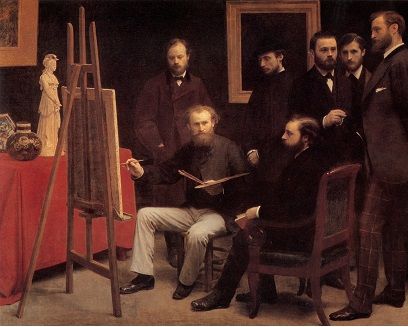
Though not yet united by whatsoever item way, the group shared a full general sense of antipathy toward overbearing academic standards of fine fine art, and decided to join a commercial cooperative, known equally the Bearding Society of Artists, Painters, Sculptors, Engravers, Etcetera. In general, the painters had very limited financial success, and few of their works were accepted for the salon exhibitions in Paris, so the company was important in establishing their financial solvency and artistic independence. In 1874, they held the first of a serial of exhibitions in the studio of photographer Felix Nadar. Information technology was not until the third exhibition in 1877 that they began to call themselves The Impressionists. While their get-go exhibition received limited public attention, and near of the viii exhibitions they held really cost coin rather than earning coin for the grouping, their later shows attracted vast audiences, with attendances running well into the thousands. Despite this attention, most members of the group sold very few works, and some of them remained incredibly poor throughout this period.
The Term "Impressionism"
The movement gained its name after the French critic Louis Leroy, whose hostile review of the start major Impressionist exhibition of 1874, seized on the title of Claude Monet'south painting Impression, Sunrise (1873). Leroy accused the group of painting nada but impressions. The Impressionists embraced the moniker, though in afterward decades they also referred to themselves as the "Independents," referring to the subversive principles of the Société des Artistes Indépendants, formed in 1884 by Impressionist painters who wanted to detach themselves from academic artistic conventions. Although the styles practiced by the Impressionists varied considerably (and in fact not all of the artists would accept Leroy's title) they were bound together by a mutual interest in the representation of visual perception, based in fleeting optical impressions, and the focus on ephemeral moments of modern life.
The Evolution of Photography
Impressionism was indebted to the science of photography. The origins of this medium are complex, spanning across nations, simply i fundamental consequence was the French inventor Louis Daguerre's unveiling of the Daguerreotype, in Paris in 1839. Daguerre had adult a technology by which images of the world could be transferred onto a copper canvas treated with silverish which reacted to light. This allowed for a direct imprint of reality to exist recorded on a two-dimensional surface, a process which revolutionized the ability to visually record the world and their own lives. By 1849, 100,000 Parisians per twelvemonth were having their photos taken.
The influence of photography on Impressionism was perchance twofold. On the one hand, it revolutionized perceptions of what was worthy of visual recreation. Academic painting in France had traditionally focused on mythical and historical subject-matter, and portraiture of national leaders and heroes. But photography fabricated it possible for all kinds of people, scenes, buildings, landscapes, to be preserved in pictorial form. This, in turn, altered some painters' sense of who and what was deserving of their attending; the café scenes, side streets, and humming squares of Impressionist paintings reflect non only a newly vibrant urban realm, but a newfound sense that this world was worth recording.

On the other manus, photography taught painters the art of spontaneous composition, and the related sense that a picture could capture a moment in time as well as a location in space. A work such equally Degas's Place de la Concorde is not and so much a painting of a public square in Paris as a painting of that square, and of the people and animals that happened to be crossing over information technology, at a particular point in time. The carefully haphazard arrangement of bodies in motion in this and many other Impressionist paintings could only have been learned via appointment with a engineering science that had the capacity to freeze and visually convey a millisecond of fourth dimension. At that place was a less pronounced sense of what the globe might wait like in this temporally specific status prior to the science of photographic reproduction.
Impressionism: Concepts, Styles, and Trends
Painting Outdoors: Claude Monet
Claude Monet is possibly the virtually historic of the Impressionists. He was renowned for his mastery of natural light and painted at many different times of 24-hour interval in an attempt to capture changing weather. He tended to create spontaneous impressions of his subjects, using very soft brushstrokes and unmixed colors to generate a subtle sense of vibration, equally if nature itself were alive on the canvas. He did non wait for pigment to dry out before applying successive layers; this "wet on moisture" technique produced softer edges and blurred boundaries that suggested three-dimensional planes rather than depicting them realistically.
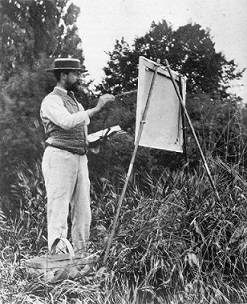
Monet'south technique of painting outdoors, known equally plein air painting, was skilful widely among the Impressionists. Inherited from the mural painters of the Barbizon School, this approach led to innovations in the representation of sunlight and the passage of time, 2 central motifs of Impressionist painting. While Monet is seen as most central to the tradition of plein air painting, Berthe Morisot, Camille Pissarro, John Singer Sargent, Alfred Sisley and many others also painted outside, lucidly portraying the transience of the natural world.
Impressionist Bodies: Degas, Renoir, and Cassatt
Other Impressionists, like Edgar Degas, were less interested in painting outdoors, and rejected the idea that painting should be a spontaneous act. Considered a highly skilled draftsman and portraitist, Degas preferred indoor scenes of modern life: people sitting in cafés, musicians in an orchestra pit, ballet dancers performing mundane tasks at rehearsal. He likewise tended to delineate his forms with greater clarity than Claude Monet and Camille Pissarro, using harder lines and thicker brushstrokes.

Other artists, such as Pierre-Auguste Renoir, Berthe Morisot, and Mary Cassatt, also focused on the human form, and on the psychology of the individual sitter or protagonist. Renoir, known for his vibrant, saturated colors, depicted the daily activities of characters from his neighborhood of Montmartre, in particular the social pastimes of Parisian society. While Renoir, like Morisot and Cassatt, also painted outdoors, he emphasized the physiognomy and emotional qualities of his subjects rather than the atmospheric conditions of the scene, using low-cal and loose brushwork to highlight the human form.
The Women of Impressionism
Whereas the male Impressionists painted figures mainly inside the public setting of the metropolis, Berthe Morisot full-bodied on the private lives of women in belatedly-19th-century club. The first adult female to showroom with the Impressionists, she created rich compositions that highlight the domestic, highly personal sphere of feminine society, often emphasizing the maternal bond betwixt female parent and child, as in The Cradle (1872). Together with Mary Cassatt, Eva Gonzalès, and Marie Bracquemond, she is considered one of the four fundamental female figures of the Impressionist motility.
Cassatt was an American painter who moved to Paris in 1866 and began exhibiting with the Impressionists in 1879. She depicted the private sphere of the home but also represented woman in the public spaces of the newly modernized city, as in her masterwork At the Opera (1879). Her paintings feature a number of innovations, including the flattening of three-dimensional infinite and the awarding of bright, fifty-fifty garish colors in her paintings, both of which heralded later developments in modernistic art.
Impressionist Cityscapes

Since the motion was deeply embedded within Parisian society, Impressionism was greatly influenced by Businesswoman Georges-Eugène Haussmann'southward renovation of the city in the 1860s. The urban project, also referred to as "Haussmannization," sought to modernize the city and largely centered in the structure of wide boulevards which became hubs of public social activity. This reconstruction of the urban center as well led to the rise of the idea of the flâneur: the idler or lounger who roams the public spaces of the city, observing life while remaining detached from the crowd. In many Impressionist paintings, the disengagement of the flâneur is closely associated with modernity and the estrangement of the individual inside the city.
These themes of urbanity are depicted in the work of Gustave Caillebotte, a later proponent of the Impressionist motility, who focused on panoramic views of the city and the psychology of its citizens. Although more realistic in style than other Impressionists, Caillebotte's images, such equally Paris, Rainy Day (1877), limited the artist's reaction to the irresolute nature of society, showing a flaneur in his characteristic black coat and tiptop lid strolling through the open up space of the boulevard while gazing at passersby. Other Impressionists depicted the fleeting qualities of motility and light inside the city, as in Monet's Boulevard des Capucines (1873) and Pissarro's The Boulevard Montmarte, Afternoon (1897). Similarly, these works emphasize the geometrical arrangement of public space through the careful delineation of buildings, trees, and streets. By applying crude brushstrokes and impressionistic streaks of color, the Impressionists evoked the rapid tempo of modern life as a central facet of late-nineteenth-century urban society.
Later on Developments - After Impressionism
Although the Impressionists proved to be a various group, they came together regularly to discuss their work and exhibit. The group collaborated on eight exhibitions between 1874 and 1886, but throughout this period they were slowly unravelling as a collective. Many felt they had mastered the early on, experimental styles that had won them attention, and wanted to motion on to explore other avenues of creativity. Others, anxious about the continued commercial failure of their work, changed grade stylistically in the hopes of attracting improve sales or patronage.
The Triumph of Impressionism
The ultimate acceptance of the Impressionist motion is largely the achievement of Paul Durand-Ruel, a French art dealer who lived in London. Monet met Durand-Ruel in 1871 and the gallerist purchased Impressionist works and exhibited them in London for many years. Sales were meager, but starting in the late 1880s, he started showing Impressionist works in the United states of america, with growing success. In the side by side few years, having exhibited in New York, Philadelphia, and Chicago, Durand-Ruel was able to entice an audition of American buyers who bought more Impressionist works than were ever sold in France. Prices for Impressionist works skyrocketed, to the point that Monet became a millionaire. Moreover, Impressionism came shut to becoming an academic orthodoxy, and so much so that a whole grouping of American painters descended on Monet's residence in Giverny to learn from the leader of the grouping.
Cezanne and the Movement to Post-Impressionism
Meanwhile, the lessons of the style were taken up past a new generation. If Manet bridged the gap between Realism and Impressionism, then Paul Cézanne was the artist who bridged the gap betwixt Impressionism and Post-Impressionism. Cézanne learned much from Impressionist technique, but he evolved a more deliberative fashion of paint handling, and, toward the end of his life, paid closer attention to the structure of the forms that his broad, repetitive brushstrokes depicted. As he once put it, he wished to "redo Poussin after nature and make Impressionism something solid and durable like the Old Masters." Cézanne wished to intermission down objects into their bones geometric constituents and depict their essential building blocks. These experiments would ultimately prove highly influential for the development of Cubism by Pablo Picasso and Georges Braque.
The Schools and Painters of Postal service-Impressionism

Such was the influence of Impressionism that its younger followers splintered off in a range of directions, forming a whole series of often curt-lived groupings and schools. Underlying the development of Post-Impressionism, still, at that place was possibly an essential split. On the ane hand there were painters and schools who focused on the use of color and brushstroke to stand for the mental and emotional life of the painter rather than the pure optical impressions conveyed by pioneers such as Monet. On the other hand, in that location were those who tried to formalize and refine the optical techniques underlying early Impressionist style.
In the first military camp are groups such as the Cloissonists, Synthetists, and Nabis, as well as individual painters whose way was never fully tied down to a detail grouping, perhaps near significantly Paul Gauguin and Vincent van Gogh. Cloisonnism emerged in the belatedly 1880s, and its early advances are often credited to the painters Émile Bernard and Louis Anquetin. Their work from this period uses big areas of vibrant color separated by thick night outlines, making the unlike colour-blocks reminiscent of the individual panels or "cloisonnes" of medieval stained-glass windows. Both painters spent fourth dimension with Van Gogh, and besides with the so-called Pont-Aven school of painters in rural Brittany, whose members included Paul Sérusier and, for a time, Paul Gauguin. Serusier, Gauguin, Bernard, and Anquetin are likewise associated with the style of Synthetism, whose techniques and origins are near-identical to Cloisonnism, except that Synthetism is less associated with the thick outlines of Cloisonnist works.
Among the most iconic works associated with the Cloisonnist-Synthetist manner are Gauguin's Vision After The Sermon (1888) and Sérusier'south The Talisman (1888), the latter of which became a lodestar for emergence of the Nabi group, whose works combined the bright, emotive block-colors of Cloisonnism with a new depth of religious and psychological symbolism. At this point, the story of Post-Impressionism starts to intersect with those of other late-nineteenth and early-twentieth-century styles such as Symbolism and Expressionism.
At the more sober, scientifically inflected end of responses to Impressionism were those of the artists associated with Pointillism, including Georges Seurat and Paul Signac. As the critic Peter H. Feist notes, these artists were heavily invested in advances in optics during the late nineteenth century, in particular the discovery - also important to the Impressionists - that "colours reached the eye in the form of lite of differing wavelengths, and were mixed in the eye to establish the color that corresponded to the object seen". Therefore, "[i]f a painter juxtaposed tiny dots of unmixed primary colours in the right way, the centre would perceive them every bit the desired color tone when looking from a certain distance; and that tone would announced lighter than if it had been mixed in the conventional fashion, on the palette or the canvas." The most famous work of Pointillism is Seurat'southward A Sunday Afternoon on the Island of La Grande Jatte (1884-86). Van Gogh'due south work, with its prominent and hypnotically repetitive brushwork, tin in a sense be seen to synthesize the pronounced stylistic qualities of Pointillism and the intense emotive appeal of the Cloisonnist-Synthetist arroyo.
Impressionism Across the World
Even as Impressionism in France was being overtaken by the advances of the Postal service-Impressionists, its legacy was travelling across continents. Amongst the most famous of the international Impressionist groupings was the American Impressionist movement, associated not just with Cassatt just with painters such as William Merritt Chase, who practical Impressionist techniques to the landscapes and bourgeois, cosmopolitan milieu of late-nineteenth-century US society; Childe Hassam, famous for his brilliant coastal and city scenes; and Maurice Prendergast, who forged a distinctive North-American Post-Impressionist style. Other notable schools of Impressionism in the Anglophone world include the Australian Impressionist school, associated with the work of Tom Roberts and Arthur Streeton, amongst others, and with the dusty colour palettes of its Antipodean climate and terrain.
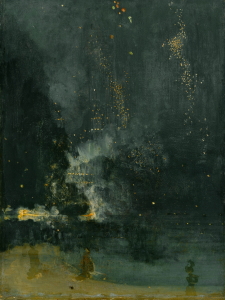
Especially pregnant was the British Impressionist movement of the late-nineteenth century. James Abbott McNeill Whistler, an American departer in London, pioneered a loose, liquid style of painting which, in his famous Nocturne serial, brilliantly conveyed the gloom and glamor of nightfall on the River Thames. Philip Wilson Steer, meanwhile, became associated with the Impressionist seascape, in particular with works focusing on the landscapes of Cornwall and the South-due west of England, while the Scot William McTaggart produced stormier marine scenes, redolent of the wilder coastal landscapes of his dwelling house country. Other important Impressionist schools emerged all over Europe, notably in Federal republic of germany, where Max Liebermann was one of the leading figures of the movement, and likewise in Holland, Belgium, and Denmark.
The Twentieth Century
Even after the demise of the Post-Impressionist schools, many artists continued to look to Impressionism. For example, although the motility is non by and large considered to have had a powerful impact on Abstract Expressionism, one can trace of import similarities in its artists' works. Philip Guston was once described every bit a latter-solar day "American Impressionist," and the surface qualities, suggestions of light, and "all-over" handling of grade in Jackson Pollock's work, all signal to the piece of work of Claude Monet.
The 1960s move of Op Art is frequently considered a radical development on the underlying logic of Impressionism and Post-Impressionism, with its emphasis on the and so-called "Responsive Eye" (a term coined for the title of a famous 1964 Op Art show in New York). Just as the Impressionists had stressed the difference betwixt how colour is perceived past the heart and how it is candy by the brain, Op Artists such every bit Bridget Riley, an avowed follower of George Seurat, based her oeuvre of visually dazzling abstruse paintings on the premise that static forms can be fabricated to seem as if in motion based on certain arrangements of line, color, and shape.
Impressionism in Music and Literature
It is too important to remember that, while Impressionism was a movement of the visual arts, it responded to, and helped to influence, a range of other media and genres. These included music - as in the dreamy, romantic piece of work of Claude Debussy and Maurice Ravel - and, most importantly, literary prose. The French writer Émile Zola was not but an impassioned defender of the Impressionist painters merely brought a representative impulse very similar to Impressionism to his writing, trying to recreate the complication of human perception and sensation through his prose. Indeed, his novels were produced across a period of time that coincides about exactly with the lifespan of the Impressionist movement.
Whereas the Impressionist sought to convey the visual appearance of a particular scene at a particular time, the writing manner which Zola developed, known as Naturalism, sought to convey the mode in which the earth appeared mentally and emotionally to a particular individual. In his 1886 book The Masterpiece, Zola even narrated the struggle of the Impressionist move in allegorical form. The novel tells the story of a young artist based in Paris struggling for recognition and acceptance of a assuming new style, only who falls foul of poverty and disinterest. The story is told in a style that transposes the visual logic of Impressionism into the world of subjective perception, idea, and feeling.
mullensthadeciagre.blogspot.com
Source: https://www.theartstory.org/movement/impressionism/history-and-concepts/
0 Response to "A World of Art Used to Describe the Concept of Imitation"
Post a Comment